


The Most Misunderstood Part of Web3
When most people hear “smart contracts,” they think of code, developers, or technical systems.
That framing is incomplete.
Smart contracts are not just a technical feature of blockchain systems—they are a new form of business infrastructure.
They redefine how agreements are executed, how processes are enforced, and how organizations coordinate activity.
At a high level, a smart contract is simply:
A self-executing agreement that runs automatically when predefined conditions are met.
But the implications of that simple idea are significant.
Smart contracts shift business operations from:
- manual → automated
- trust-based → verification-based
- intermediary-driven → system-driven
From Contracts to Systems
Traditional contracts define what should happen.
Smart contracts ensure that it does happen.
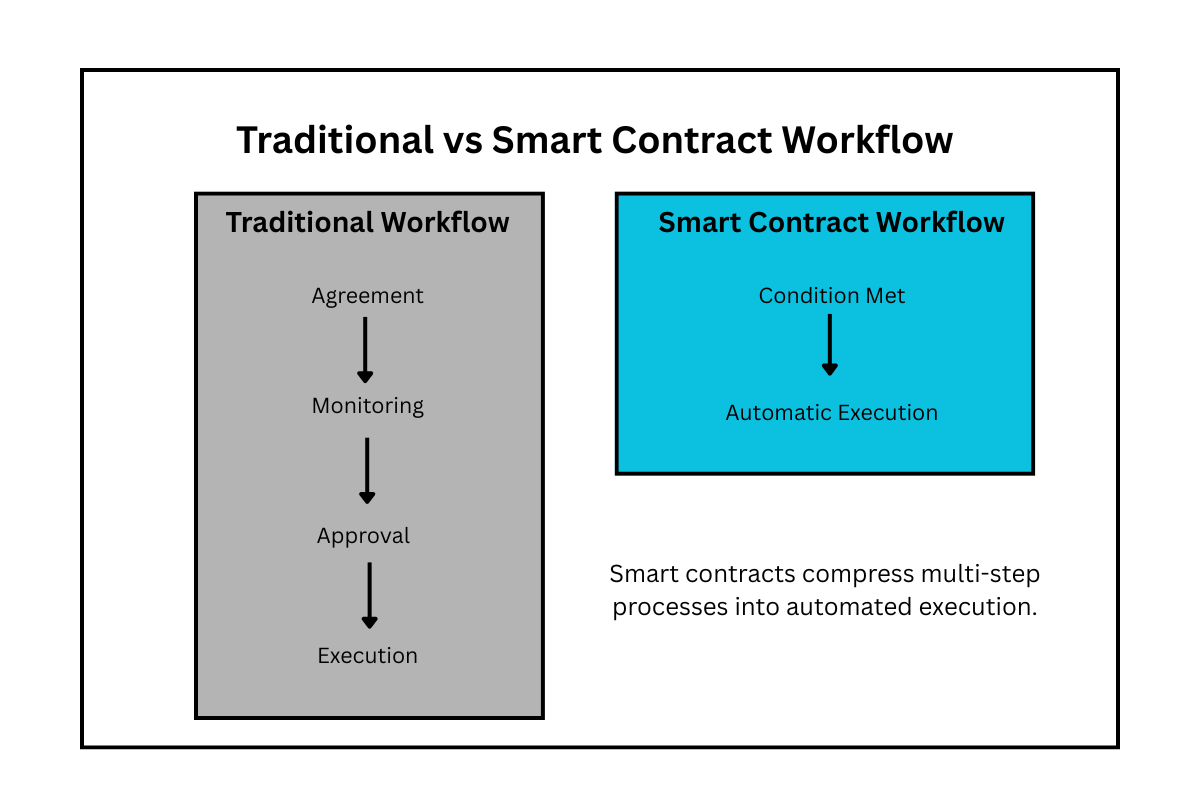
In a typical business process:
- agreements are written
- conditions are monitored
- execution depends on people or institutions
This introduces friction:
- delays
- administrative overhead
- enforcement risk
- reconciliation errors
Smart contracts collapse these layers into a single system.
Once deployed, they:
- monitor conditions automatically
- execute actions instantly
- record outcomes transparently
This is not just contract digitization—it is process automation at the infrastructure level.
What Smart Contracts Actually Do
Smart contracts are best understood through what they enable operationally.
They can:
- Execute payments automatically
(e.g., release funds when milestones are met) - Control access dynamically
(e.g., grant entry based on token ownership) - Enforce rules consistently
(e.g., royalties, revenue splits, permissions) - Coordinate multi-party activity
(e.g., supply chain validation, shared systems)
In each case, the key feature is the same:
Execution is embedded in the system—not dependent on oversight.
Where This Matters Most for Businesses
Smart contracts are not equally relevant everywhere. Their value is highest in areas with:
- multiple parties
- repetitive processes
- conditional logic
- trust or reconciliation requirements
Three areas stand out.
1. Payments and Financial Operations
Smart contracts can automate:
- milestone-based payments
- revenue splits
- royalties
- escrow and settlement
Instead of manually approving and reconciling transactions, businesses can define rules once and allow the system to execute them.
This reduces:
- operational overhead
- delays
- disputes
2. Access, Membership, and Identity
Smart contracts can control:
- subscriptions
- loyalty tiers
- event access
- gated content
Access becomes programmable, not manually managed.
For example:
- a customer holds a token → access is granted automatically
- a membership expires → access is revoked automatically
This creates more dynamic and scalable systems.
3. Multi-Party Coordination
Many business processes involve coordination across organizations.
Examples include:
- supply chains
- partnerships
- marketplaces
Smart contracts allow all participants to interact with a shared system of record, reducing:
- reconciliation
- disputes
- dependency on intermediaries
The Strategic Shift: From Process to Infrastructure
Most companies think of operations as workflows.
Smart contracts shift operations toward infrastructure design.
Instead of asking: “How do we manage this process?”
Businesses can ask: “How do we design a system where this process runs automatically?”
This changes the role of leadership.
The focus moves from:
- managing execution
to - designing systems that execute
Benefits — and Where They’re Real
Smart contracts offer clear advantages, but they are not universal solutions.
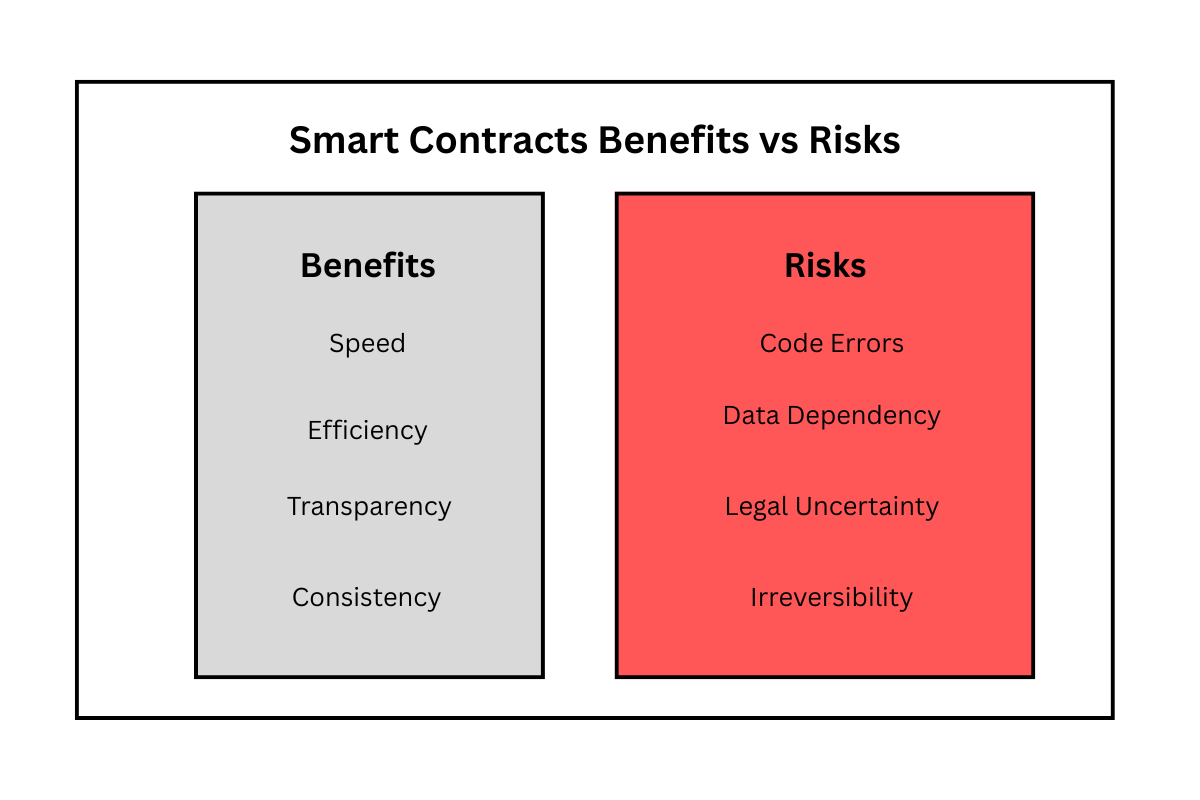
Benefits
- Speed — instant execution
- Efficiency — reduced manual processes
- Transparency — visible and auditable logic
- Consistency — rules applied uniformly
Where They Work Best
- repeatable processes
- clearly defined conditions
- digital or digitized assets
- multi-party environments
Risks and Limitations
Smart contracts also introduce new considerations.
1. Code Risk
If the logic is flawed, the contract executes incorrectly.
There is no “manual override” without additional design.
2. Data Dependency
Smart contracts rely on inputs.
If the input data is incorrect, execution will still occur.
3. Legal Alignment
Smart contracts do not automatically replace legal contracts.
Businesses must ensure:
- regulatory compliance
- enforceability
- proper structuring
4. Irreversibility
Once deployed, changes are difficult.
This requires careful design upfront.
Where Businesses Should Start
Smart contracts do not require a full transformation to begin.
The most effective approach is to start small and targeted.
Step 1 — Identify Friction
Look for:
- delays
- manual approvals
- reconciliation issues
Step 2 — Choose a Contained Use Case
Good starting points:
- loyalty systems
- access control
- internal payments
- vendor agreements
Step 3 — Prototype
Build a limited implementation:
- small user group
- controlled environment
- clear metrics
Step 4 — Evaluate and Expand
Measure:
- efficiency gains
- cost reduction
- user experience improvements
Then expand deliberately.
Smart Contracts Are Not About Code — They’re About Design
The most important insight for business leaders is this:
Smart contracts are not a technical feature.
They are a way of designing how systems operate.
Companies that approach them as infrastructure—not experimentation—will gain the most value.
The Strategic Takeaway
Smart contracts represent a shift from:
- process → automation
- oversight → execution
- intermediaries → systems
They allow businesses to embed logic directly into the way operations run.
For organizations willing to rethink how work gets done, this creates an opportunity to reduce friction, increase efficiency, and design more resilient systems.
Building with Smart Contracts
At Argot, we help organizations identify where smart contracts create real operational value—and where they don’t.
The goal is not to adopt technology for its own sake, but to align automation with business outcomes.
→ Learn more at argotagency.io