


Executive Summary
Smart contracts are self-executing programs that run on blockchains—automating agreements, workflows, and transactions without the need for intermediaries. For businesses, they represent the next leap in digitization: rules-based logic combined with immutable ledgers opens new doors for efficiency, transparency, and security.
From financial operations to supply chain coordination to customer loyalty programs, smart contracts are becoming the backbone of decentralized applications (dApps) and enterprise automation. This explainer breaks down what they are, how they work, why they matter, and how a business can begin experimenting responsibly.
Across industries, businesses are increasingly asking a similar question: What can we actually do with blockchain?
While headlines often focus on crypto prices or NFTs, the most transformative innovation in Web3 is far more practical and business-oriented: smart contracts.
Smart contracts are the hidden engine powering nearly every decentralized application—from financial platforms to supply chains to loyalty programs. They automate workflows, enforce rules, and execute transactions without intermediaries. For companies looking to improve efficiency, cut costs, and future-proof operations, smart contracts are quickly becoming impossible to ignore.
What Exactly Is a Smart Contract?
A smart contract is a piece of code stored on a blockchain that automatically runs when predetermined conditions are met. Think of it as a digital version of a contract—except instead of relying on lawyers or trusted intermediaries to enforce it, the contract enforces itself.
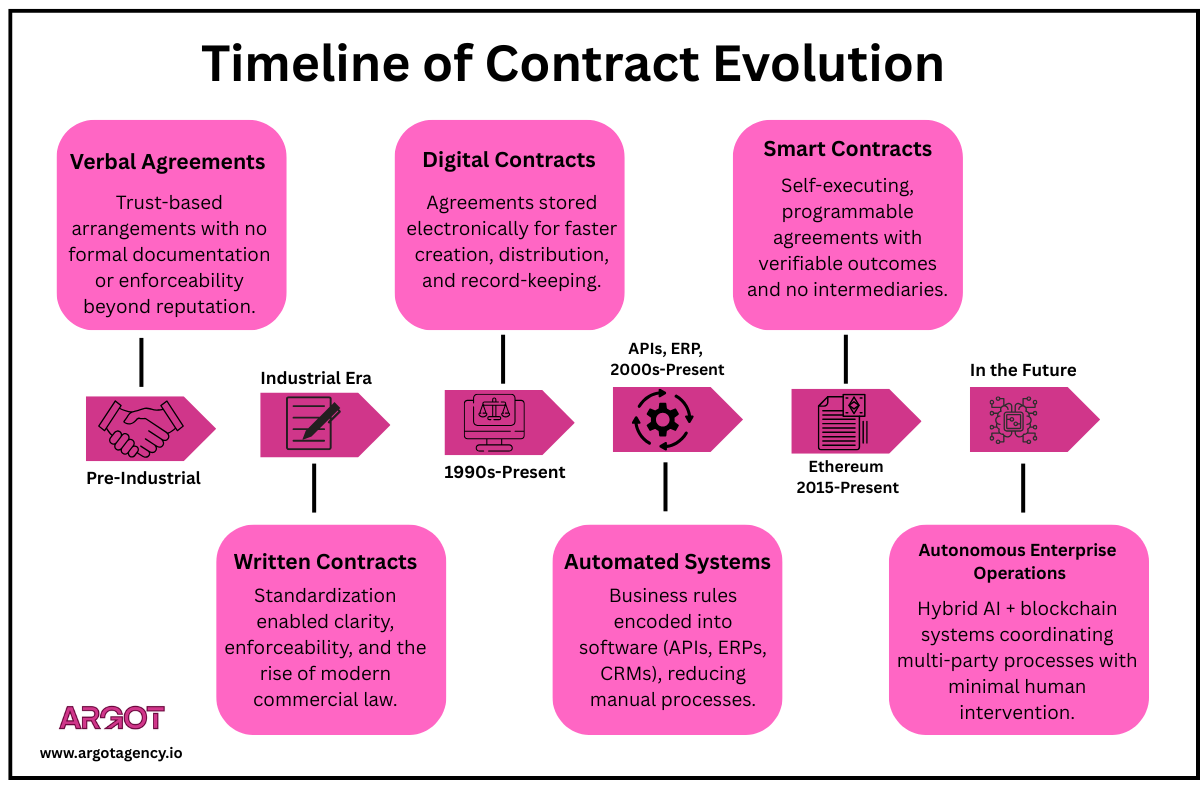
This idea was first introduced by cryptographer Nick Szabo in the 1990s, but it became practical only with the rise of Ethereum in 2015, which allowed developers to deploy programmable logic onto decentralized networks.
If Condition X happens, automatically perform Action Y.
No delays. No approvals. No ambiguity.
Szabo’s oft-cited analogy for the smart contract is a vending machine transaction. You put $1.00 into the machine, choose soda X by hitting the button, and then the vending machine drops your soda. Simple and automatic.
You may be thinking: “Cute example. But my business deals with multi-step approvals, compliance checks, variable pricing, data integrations… not soda machines.”
Fear not, while Szabo’s vending machine analogy illustrates the concept of self-executing logic, modern smart contracts go far beyond simple if–then triggers.
Today’s smart-contract systems can handle multi-party approval workflows, dynamic pricing models, conditional compliance checks, tiered access rights, data pulled from external systems, milestone-based payments, and even automated dispute-resolution mechanisms.
In other words: smart contracts aren’t simple—they start simple.
Just as an invoice system, CRM, or ERP began as a basic digital ledger before evolving into enterprise-grade platforms, smart contracts have matured into modular, auditable, and highly customizable automation layers that can reflect the complexity of real business processes.
The important point is not that your transactions look like vending machine transactions—they don’t.
It’s that the same principle of rules-based automation can be scaled to fit workflows involving dozens of steps, multiple parties, and conditional logic that mirrors your existing operations. Smart contracts simply execute these rules with perfect consistency, transparency, and autonomy once they’re deployed.
How They Work (In Non-Technical Terms)
To make this more concrete: a smart contract can release payment only if:
(1) goods are confirmed delivered,
(2) a compliance check passes,
(3) three department managers approve the milestone, and
(4) market pricing data meets your predefined tolerance range.
Each of these conditions can be automatically validated via on-chain logic, or securely imported using trusted data oracles.
This is why enterprises are increasingly exploring smart contracts—not because their business resembles a vending machine, but because their most complex processes are built on rules and conditions that are perfectly suited for programmable automation.
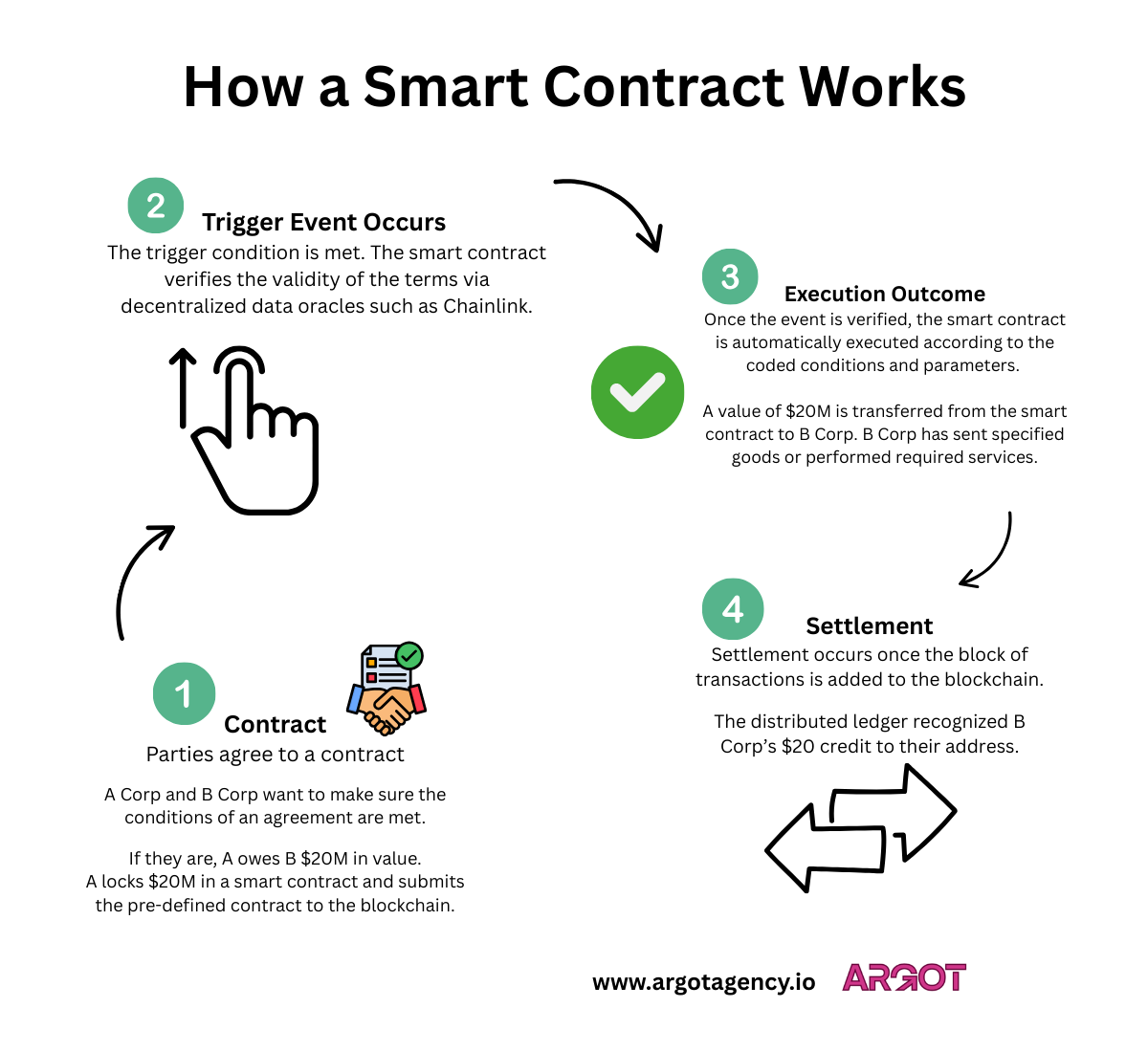
A smart contract typically includes:
- Inputs or triggers (e.g., a timestamp, a payment, or a delivery update)
- Business logic (the rules—if/then conditions)
- Execution outputs (payment release, data update, token creation, rights granted)
- An audit trail stored immutably on the blockchain
Once deployed, no party can secretly change the rules. Everyone sees the same logic and the same outcomes.
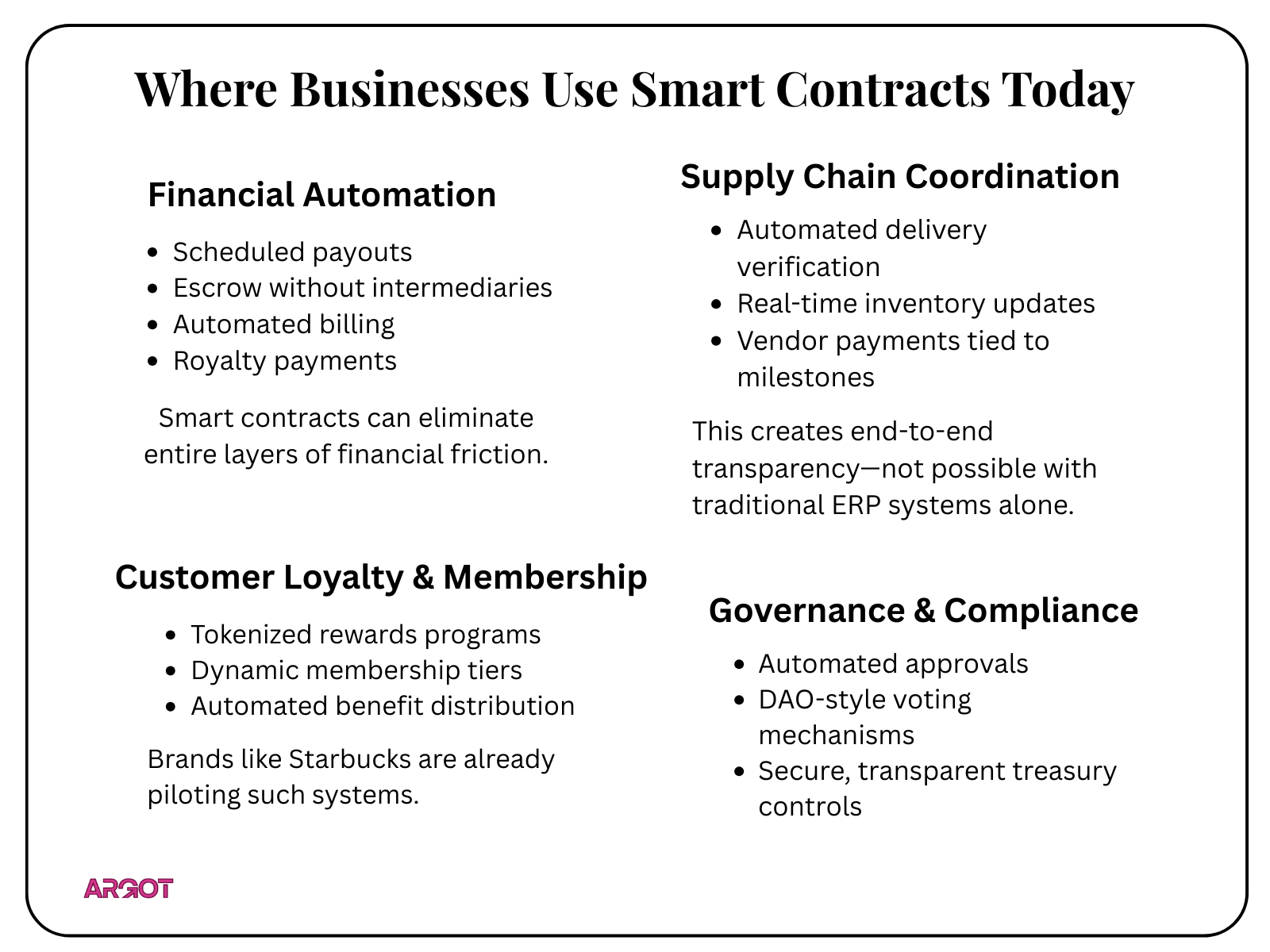
Where Businesses Use Smart Contracts Today
Across sectors, smart contracts are becoming the backbone of automated operations and trusted data exchange. Several industries are leading adoption and finding specific business functions where smart contracts are creating meaningful efficiency and control.
Why They Matter for Your Business
Smart contracts unlock a new form of operational intelligence:
- Reduce manual work
- Eliminate reconciliation errors
- Create trustless systems between partners
- Simplify audits
- Enable programmable money and programmable rights
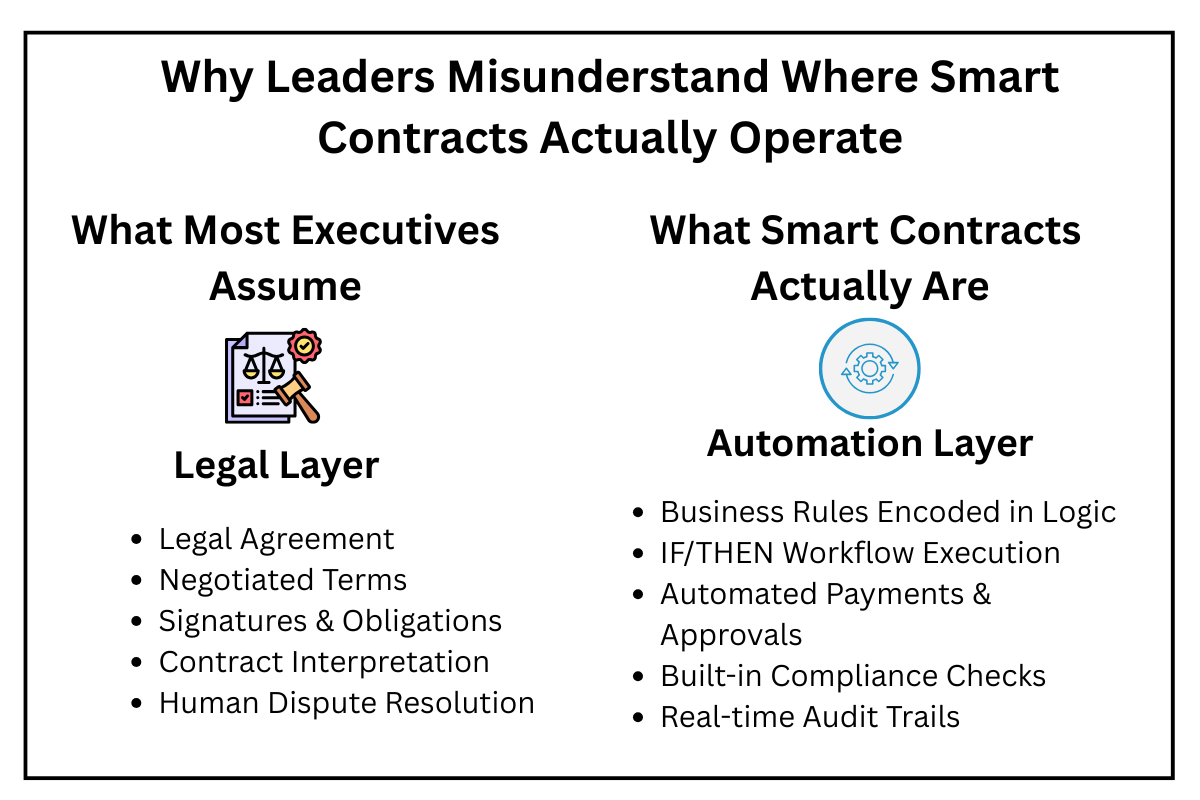
They don’t replace legal contracts—they complement them by enforcing the mechanical aspects of agreements instantly and accurately.
The Risks & Limitations
Smart contracts are powerful—but not perfect.
- Bugs can be costly due to immutability
- Logic needs to be precise
- Off-chain data introduces risks
- Regulations are still evolving
- Specialized auditors are required
Every Transformational Technology Looks Risky at First
Smart contracts come with real risks—but so did cloud computing, mobile payments, and ERP automation. The companies that gained the largest competitive advantages weren’t the ones who waited until every risk disappeared. They were the ones who engaged early, with discipline and guardrails. Smart contracts are following the same adoption curve.
The Strategic Risk Isn’t Adoption—It’s Asymmetry
Your competitors, partners, and even customers are already adopting blockchain-based automation. The greatest risk is not deploying smart contracts—it’s discovering two years from now that your value chain has evolved without you.
Doing Nothing Is Not Risk Neutral
It feels safer to preserve the status quo, but standing still has a cost:
- slower settlement cycles
- higher operational overhead
- fragile reconciliation processes
- fragmented data flows
- missed automation opportunities
Smart contracts directly target these inefficiencies. Ignoring them quietly compounds operational drag.
Responsible Deployment Isn’t Vague—It’s a Framework
“Responsible deployment” means:
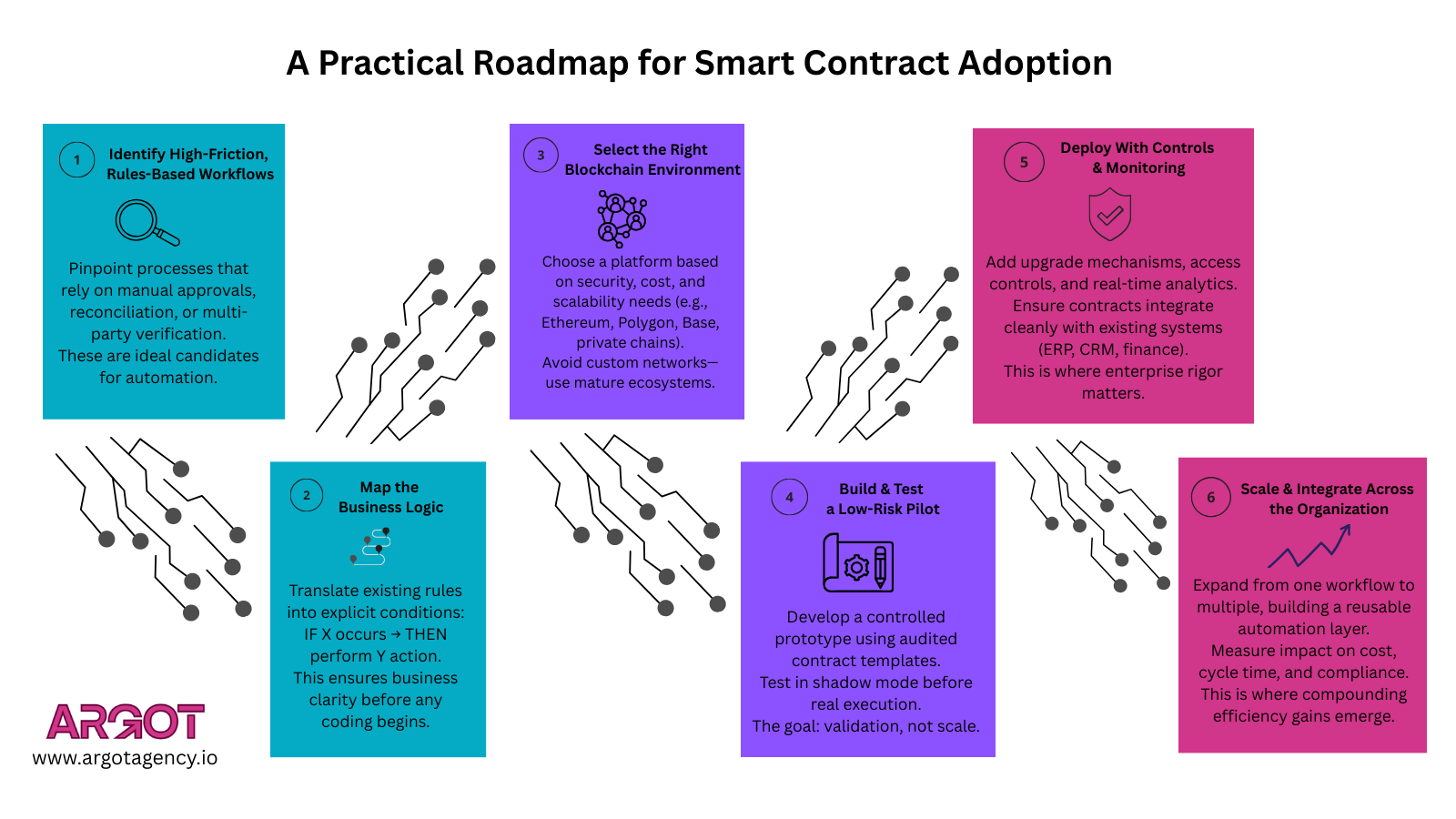
- Start with low-risk pilots
– automate a simple approval flow, loyalty reward, or milestone payment. - Use audited, open-source, battle-tested contract libraries
– minimize custom code; maximize security. - Run the system in shadow mode before going live
– observe behavior without financial implication. - Integrate governance and upgrade paths
– modern smart contracts can include safe methods for correction and iteration. - Limit contract authority through modular design
– one contract should never control more than it needs to. - Use enterprise-grade monitoring tools
– track execution, anomalies, and performance just like a cloud system.
Modern enterprise deployment includes:
- leveraging audited, proven contract libraries
- running contracts in shadow mode before activation
- modular designs that limit contract authority
- upgrade paths for safe iteration
- continuous on-chain monitoring
This is not experimental technology anymore—it’s structured, auditable automation.
You Don’t Need Smart Contracts for Everything. But You Do Need to Understand Them.
The point isn’t to replace all systems with smart contracts. The point is to ensure your company can operate in a world where:
- payments settle instantly,
- compliance is automated,
- trust is programmable, and
- partners expect verifiable workflows.”
Early Movers Capture Compounding Advantage
Smart contracts may not transform your operations overnight, but early adopters accrue advantages that laggards cannot easily replicate: faster cycle times, lower overhead, real-time auditability, and stronger interoperability with modern digital ecosystems.
Key Takeaway:
The risk of smart contracts is manageable and predictiable. The greater risk is falling behind as others move ahead.
How to Begin Exploring Smart Contracts
Start small. Look for processes that are rules-based, repetitive, and rely on multiple parties. Examples:
- Vendor or contractor payments
- Loyalty rewards
- Milestone-based billing
- Access control (“grant user access for 30 days after purchase”)
Choose a blockchain that matches your business needs—Polygon for scale, Ethereum for security, Base for low-cost innovation, or a private enterprise chain for internal systems.
Finally, always conduct a professional audit. Security is non-negotiable.
The Bottom Line
Smart contracts are not futuristic—they are practical tools ready for deployment today. Businesses that understand how to harness them will gain a decisive edge in automation, transparency, and digital coordination.
And as more of the global economy shifts on-chain, the companies with smart-contract-enabled processes will be the ones defining the future of business operations.
Further Resources
Argot Explainer Series:
- What is an oracle?
- What are Smart Contact Standards? ERC-20, ERC-721 Compared.
Outside Resources:
- Harvard Business Review (2017): The Truth About Blockchain
- Consensys- Smart Contract Security Mindset
- MIT Sloan Review: Unleashin the Power of Blockchain in the Enterprise
If your organization is evaluating how smart contracts could unlock automation, transparency, or cost efficiency, Argot provides structured assessments, pilot design, and implementation guidance to support responsible adoption.
About Argot
Argot is a Web3-focused strategy and advisory firm helping organizations evaluate, design, and deploy blockchain-based business models, smart-contract automation, token ecosystems, and digital infrastructure. We combine enterprise rigor with technical depth to help leaders navigate the decentralized future.